

You have 4 options when registering a company in Bangladesh as a foreign investor. Each one carries different compliance obligations, different registration authorities, and suits a different business situation. The right structure depends on whether you want to earn revenue locally, maintain equity control, or simply test the market.
This guide covers all 4 types, compares them directly, and tells you which structure fits your situation. If you’ve already decided and need the step-by-step process, documents, and costs, see how to register a company in Bangladesh.
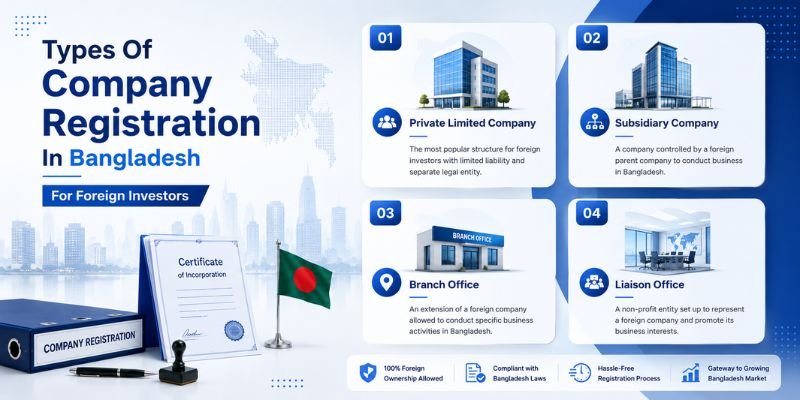
The 2 ways you can enter Bangladesh as a foreign company
Before picking a specific entity type, understand the 2 entry modes. They determine which government body you register with, how liability sits, and what you can and can’t do commercially.
Equity-based entry: incorporate a subsidiary. You register a private limited company (subsidiary) under the Bangladesh Companies Act 1994. RJSC (Registrar of Joint Stock Companies and Firms) handles the registration. Your company becomes a separate legal entity from the parent. It can own assets, earn revenue, and declare profits independently.
Non-equity-based entry: set up a branch or liaison office. You register an extension of your existing company in Bangladesh. BIDA (Bangladesh Investment Development Authority) governs this. There’s no shareholding structure. Your parent company remains fully liable for everything the Bangladesh office does.
Subsidiary company
The subsidiary is the most popular structure for foreign corporate investors entering Bangladesh. It’s a private limited company where your parent company holds all or most of the shares. It operates as a separate legal entity and gets the same tax and regulatory treatment as a locally incorporated company.
A foreign parent company holds the shares, and the Bangladeshi entity stays a separate legal person. KAC handles the RJSC filing and the parent company documentation as part of subsidiary company setup.
Right for you if: you’re a foreign corporation that wants to trade commercially in Bangladesh, earn and repatriate revenue, and keep the parent company’s liability ring-fenced.
Key registration requirements
- Minimum 2 shareholders, maximum 50
- Minimum 2 directors
- 100% foreign shareholding is permitted
- Minimum paid-up capital: BDT 1 per shareholder
- Registered office address in Bangladesh required
- If your shareholder is a corporate entity, it must nominate a representative director
Ongoing compliance obligations
Once operational, a subsidiary has 14 or more scheduled filings per year. Budget for these from day one.
- RJSC: Annual return and audited financial statements filed every year
- NBR: 2 monthly TDS (Tax Deducted at Source) returns, 1 half-yearly TDS statement, 2 annual TDS returns, and 1 annual corporate income tax return
- VAT Authority: Monthly VAT return and VAT record books maintained
- Bangladesh Bank: Quarterly FDI (Foreign Direct Investment) reporting
- Local government: Annual trade license renewal
- AGM: Annual general meeting required within 18 months of incorporation, then every year after
- Registered with: RJSC
- Tax status: Resident, 27.5% corporate tax rate, eligible for tax benefits
Private limited company
A private limited company is structurally identical to a subsidiary. The difference is who holds the shares. Here, shareholders are natural persons (individuals) rather than a corporate entity. This is the right structure if you’re an individual foreign investor or if you and a local partner are co-investing as individuals.
Right for you if: you’re investing personally, not through a corporate holding company, or if you’re forming a joint venture with an individual rather than another corporation.
Incorporating at RJSC has its own paperwork, and the RJSC document requirements differ depending on whether your shareholders are individuals or companies. KAC manages the filing end to end through private limited company setup.
Key registration requirements
- Minimum 2 shareholders, maximum 50
- Minimum 2 directors
- 100% foreign shareholding is permitted
- Minimum paid-up capital: BDT 1 per shareholder
- Registered office address in Bangladesh required
- Shares can’t be publicly traded or freely transferred
Ongoing compliance obligations
Compliance is identical to a subsidiary. Same filing schedule, same government bodies, same deadlines.
- RJSC: Annual return and audited financial statements
- NBR: Monthly TDS returns, annual income tax return
- VAT Authority: Monthly VAT return
- Bangladesh Bank: Quarterly FDI reporting (if foreign-owned)
- Local government: Annual trade license renewal
- AGM: Annual general meeting required each year
Every deadline and penalty is set out in private limited company compliance.
One thing we see slow down private limited registrations: corporate shareholders with layered ownership structures. If one of your shareholders is itself a holding company, you’ll need a share tree analysis tracing the ultimate beneficial ownership. That document requires legal preparation in the home country and can add 2-3 weeks to your timeline.
- Registered with: RJSC
- Tax status: Resident, 27.5% corporate tax rate
Branch office
A branch office is an extension of your foreign company in Bangladesh. It can carry out commercial activities, but only the same activities your parent company performs at home. It can’t manufacture goods. Your parent company bears full legal and financial liability for whatever the branch does here.
Right for you if: your parent company is already an established business and you want to operate commercially in Bangladesh under the same brand, without incorporating a separate local entity. KAC handles BIDA permission and the RJSC filing through branch office setup.
Key registration requirements
- Your parent company must be at least 2 years old as a formally registered company outside Bangladesh
- Minimum initial remittance: USD 50,000 within 2 months of BIDA approval
- Your branch name must be identical to the foreign parent company name
- BIDA approval is mandatory before you can do anything else
- RJSC registration follows after BIDA approval
- You can only carry out BIDA-approved activities, nothing outside those
Ongoing compliance obligations
Branch offices carry more ongoing complexity than subsidiaries in 1 specific area: BIDA. Every material change to your business requires going back to BIDA for an amendment.
- BIDA: Quarterly activity and financial reports. Your BIDA permission must be renewed every 3 years, and you need to apply at least 2 months before expiry
- NBR: Monthly TDS returns, annual income tax return filed at the non-resident corporate rate (you don’t get resident tax benefits)
- VAT Authority: Monthly VAT return and VAT record maintenance
- Local government: Annual trade license renewal
- Activity changes: If your parent company’s core business changes, you’ll need a BIDA amendment application for the branch. This typically takes 6-8 weeks and your Bangladesh operations can’t expand into the new activity until it’s approved
- Registered with: BIDA, then RJSC
- Tax status: Non-resident, 30% tax rate, no resident tax benefits
Liaison / Representative office
A liaison office is the most restricted structure. It can’t earn revenue in Bangladesh. Its only permitted activities are non-commercial: market research, customer coordination, trade facilitation, and feasibility studies. Every cost must be funded by your parent company through inward remittances.
Right for you if: you want a presence in Bangladesh to research the market or coordinate locally before committing to a full registration. It’s a low-commitment entry point, not a permanent operating model. KAC obtains the BIDA permission as part of liaison office setup.
Key registration requirements
- Your parent company must be at least 2 years old as a formally registered company outside Bangladesh
- Minimum initial remittance: USD 50,000 within 2 months of BIDA approval
- Your office name must be identical to the foreign parent company name
- BIDA approval is mandatory. You can’t earn revenue or sign commercial contracts
- No profit tax applies since there’s no revenue, but other tax obligations still exist
Ongoing compliance obligations
No revenue doesn’t mean no compliance. We see clients surprised by this. Your liaison office still has mandatory reporting obligations.
- BIDA: Quarterly activity reports showing only non-commercial activities. Permission renewal every 3 years
- NBR: Monthly TDS returns on employee salaries and vendor payments. Annual TDS certificates issued to all employees. Annual income tax return is mandatory even though there’s no profit tax payable
- Local government: Annual trade license renewal
- Bank: All operating costs must come through parent company remittances into your Bangladesh bank account, and you can’t receive any local payments
One situation we see regularly: a company sets up a liaison office, a commercial opportunity appears, and they can’t act on it. A liaison office has no legal authority to sign contracts or issue invoices. Converting to a branch office means a fresh BIDA application, a new USD 50,000 remittance, and 8-10 weeks of processing. The trade-offs between the two are set out in branch office vs liaison office.
If there’s any realistic chance you’ll want to earn revenue within 18 months, pick a branch office or a subsidiary from the start. A liaison office can’t invoice anyone, and switching later means a fresh BIDA application, another USD 50,000, and 8-10 weeks of waiting.
- Registered with: BIDA only, no RJSC filing
- Tax status: No profit tax. TDS on salaries and vendor payments, plus an annual income tax return, are still mandatory
Side-by-side comparison of all 4 options
| Criteria | Subsidiary / Private Limited | Branch Office | Liaison / Representative Office | Private Limited (local) |
|---|---|---|---|---|
| Legal entity? | Separate legal entity | Extension of foreign parent | Extension of foreign parent | Separate legal entity |
| Can earn revenue? | Yes | Yes (BIDA-approved activities only) | No | Yes |
| Registered with | RJSC | BIDA + RJSC | BIDA | RJSC |
| Min. investment | BDT 1 per shareholder | USD 50,000 | USD 50,000 | BDT 1 per shareholder |
| Corporate tax rate | 27.5% | 30% | Not applicable | 27.5% |
| Foreign ownership | Up to 100% | N/A (extension of parent) | N/A (extension of parent) | Up to 100% |
| Min. shareholders | 2 | N/A | N/A | 2 |
| Min. directors | 2 | N/A | N/A | 2 |
| Compliance filings | RJSC, NBR, VAT, FDI reporting | BIDA, NBR, VAT | BIDA, NBR | RJSC, NBR, VAT, FDI reporting |
| Valid period | Until dissolved | Until BIDA permission expires (renewable) | Until BIDA permission expires (renewable) | Until dissolved |
| Liability | Subsidiary only | Parent company fully liable | Parent company fully liable | Company only |
Which structure is right for your situation?
The subsidiary is the right answer for most foreign investors. It gives you a separate legal entity, full commercial freedom, resident tax status, and unlimited operational scope. The other 3 structures exist for specific situations, not as alternatives to the subsidiary.
Choose a subsidiary if you’re a foreign corporation entering Bangladesh to trade, earn revenue, and repatriate profits. This is what we recommend to most of our clients.
Choose a private limited company if you’re an individual foreign investor rather than a company, or if you’re forming a joint venture between individuals. The structure is identical to a subsidiary in every way except the shareholder type.
Choose a branch office if your parent company is established and you want to operate commercially in Bangladesh under the same brand without incorporating locally. Accept that your parent bears full liability, and that any change to your permitted activities means going back to BIDA.
Choose a liaison office only if you need a presence purely for market research or coordination with no plans to earn revenue. Convert to a branch or subsidiary before you sign your first commercial contract.
Ready to register your company in Bangladesh?
We use the KAC Foreign Investor Expansion Process to guide every foreign client from entity selection through full registration. We handle RJSC incorporation, BIDA approvals, bank account opening, TIN registration, and VAT/BIN registration.
Start here: company formation in Bangladesh. We’ve helped foreign investors get incorporated since 2012, or talk to our team about your structure.

Frequently asked questions
What is the most common type of company registration in Bangladesh for foreign investors?
The subsidiary company. It’s a separate legal entity from the parent, allows 100% foreign ownership, earns revenue under resident tax status at 27.5% corporate tax, and limits the parent company’s liability. Most foreign corporations entering Bangladesh commercially use this structure.
Can a foreign company register a branch office in Bangladesh without BIDA approval?
No. BIDA (Bangladesh Investment Development Authority) approval is mandatory before a branch office can legally operate. Without the BIDA permission letter, you can’t open a bank account, register with RJSC, or remit operating funds. BIDA approval typically takes 4-6 weeks.
What is the difference between a branch office and a liaison office in Bangladesh?
A branch office can earn revenue through BIDA-approved commercial activities. A liaison office can’t earn any revenue. Both require BIDA approval and an initial remittance of USD 50,000. The branch pays corporate tax on income; the liaison office doesn’t, as it generates no taxable income.
Is 100% foreign ownership allowed for company registration in Bangladesh?
Yes. Under the Bangladesh Investment Development Authority Act, 100% foreign ownership is permitted for most sectors. Restricted sectors such as defence and nuclear energy require local partnership or government approval. For most manufacturing, services, and IT businesses, full foreign ownership is allowed.
What is the minimum capital required to register a company in Bangladesh?
For a private limited company or subsidiary, the minimum paid-up capital is BDT 1 per shareholder. There’s no minimum threshold under the Bangladesh Companies Act 1994. For a branch or liaison office, you must remit a minimum of USD 50,000 to Bangladesh within 2 months of BIDA approval.